

August 12, 2014
ARTISTAS SEAN UNIDOS | OLIVER BLOHM! MICROONDAS & FOTOGRAFIAS POLAROID!
I love the mystic of Sarah Moon, the light painting of Paolo Roversi, the straightness of Richard Avedon, the morbid worlds of Joel Peter Witkin and the strong woman of Helmut Newton. But influnces and inspirations are everywhere, you just try to let your eyes open enough.

August 3, 2014
NATURPIXEL | EL MICROONDAS COMO REVELADOR FOTGRÁFICO

EL MICROONDAS COMO REVELADOR FOTGRÁFICO
-------------------------------------------------
El fotógrafo Oliver Blohm decidió un día experimentar con las Polaroids y un microondas. A pesar de que The Impossible Project ha hecho un buen trabajo manteniendo este formato analógico, hay una ligera diferencia con el original, y es que tarda unos 30-40 minutos en revelarse la imagen, en comparación con los 2 minutos que se tomaba Polaroid .
Por eso, Blohm intentó acelerar este proceso de alguna manera. Al final utilizó un microondas y una especie de escudo hecho de cartón y cristal, con ello consiguió revelar en dos minutos aproximadamente, pero con lo que no contaba es con que hubiera efectos secundarios.
.
Dado que no se pueden controlar las ondas del electrodoméstico, la foto final siempre tenía texturas, formas y zonas quemadas. Sin embargo, aunque al principio tomó esto como un fallo en su experimento, finalmente lo usó como toque personal para crear una serie de imágenes únicas, que agrupó bajo la serie llamada Hatzfrass/Fast Food.
.
Con estas fotografías se ganó la atención de The Impossible Project y fue invitado para que mostrara su proceso, tanto en Viena como en Berlín, en la apertura de una tienda.
---
FULL ARTICLE
July 4, 2014
ABSOLUTE PHOTO MAG | OLIVER BLOHM (APP MAGAZINE)


OLIVER BLOHM
-------------------------------------------------
In 2009 I found out about Polaroid and instant film, and the following year borrowed an SX-70 from a friend to shoot with in the summer. I wanted to use the SX-70 as it’s a small-sized, large-format camera and I filled empty integral film cassettes with large-format negatives and exposed them for a portrait project. It worked and I realised my first book project, SX-70 Negative. A year later I made a spontaneous purchase on eBay – a Polaroid 600SE. I started to work with the old Polaroid material, which is now my most used and loved medium.
My favourite camera is my Polaroid 600SE. The camera
has a great lens and changeable backs. I still love to play
with the Polaroid SX-70 and sometimes I use my red
Polaroid 645 CL to take spontaneous pictures too. One of
my favourite cameras is the Rollei 35 LED, it‘s small and
takes amazing pictures. My newest toy is an unlicensed
Polaroid camera which uses the same film as the SX-70,
it‘s a Keystone Wizard, or as I like to call it, ‘the tank’.
Using Polaroid cameras successfully very much
depends on the rules of photography. In my point of view
you just need to find your own way to handle this little
disaster. I love the old Polaroid material and I‘m very sad
that I’d only just got to know it when Polaroid declared
bankruptcy. Working with Impossible I sometimes find very strange. The biggest difference is that I used to work with
the peel-a-part film whereas Impossible only produces the
integral film. The long development times are often hard
to handle but they‘re improving the chemicals and want
to launch a new film in late summer which should show a
picture after just a few minutes without colour, but you can
see what you have after three or four minutes, which is a
big step forward for them. The colours will then appear in
around 20 minutes.
With the developing times in my mind, one day I had the
idea of heating the photographs while developing them –
just for fun. I realised that they developed way faster, but
that the heat destroyed the pictures. I already knew from
previous experiments that it’s not helpful to cook them,
so I decided to misuse my flatmate’s microwave. At first
the radiation started to burn the pictures because of the
metallic elements in the film, but at least the Polaroids
developed in just a few minutes. I just needed to find a
way to save the photograph and get better control of
the nuking process. In the end, I was able to reduce the
development time of 40 minutes to three to five minutes.
Nearly all my photos are made with analogue material,
preferably with old Polaroid film, which has its own aura,
look and feel. That includes the mistakes and failures
depending on the chemicals, which is often very old and
out of date. This characteristic generates unique and
surreal structures as well as missing parts of the image.
The material is not 100% predictable and for me, that
creates room for the unexpected.
---
ABSOLUTE PHOTO MAG
June 23, 2014
CULTURA COLECTIVA | EL FOTÓGRAFO OLIVER BLOHM

EL FOTÓGRAFO OLIVER BLOHM
-------------------------------------------------
Polaroid se hizo internacionalmente conocida por sus instantáneas, mismas que se volvieron un recuerdo cuando en 2008 se descontinuó la cámara que las producía. Desde entonces, The Impossible Project se ha encargado de producir y comercializar instantáneas utilizando equipo idéntico al de Polaroid. Sin embargo, el material para su fabricación es diferente, y las películas producidas por The Impossible Project requieren de 30 a 40 minutos para ser completamente reveladas, en contraste con el material empleado por Polaroid, con un tiempo de revelado de dos minutos.
Oliver Blohm es un fotógrafo quien ha experimentado con los productos de The Impossible Film; con el uso de un microondas, un pedazo de cartón húmedo y vidrio ha logrado reducir los tiempos de revelado a dos minutos; los resultados tienen un interesante efecto a partir de diferentes colores, formas y texturas.
Blohm aprovechó su descubrimiento y desde entonces continúa experimentando con retratos procesados de esta manera en un proyecto llamado: Hatzfrass/Fast Food. El efecto es similar al de una película procesada con los químicos erróneos, combinado con el de antiguas fotografías que fueron quemadas.
In a series he calls Hatzfrass/Fast Food, Blohm set out to reinvent Polaroid film processing using a microwave and a shield that is based on a wet carton and glass, shortening the development back to 2-3mins. One of the most unique things about Blohm’s project is that you don’t need filters, presets or actions for a cool effect, you’ll get textures, burned sections, odd shapes, and acid washed colors out of it.
---
FULL ARTICLE
DPA | LIEBER ANALOG - VON DER NEUEN LIEBE ZUR ALTEN TECHNIK (ASSORTMENT OF PUBLICATIONS)


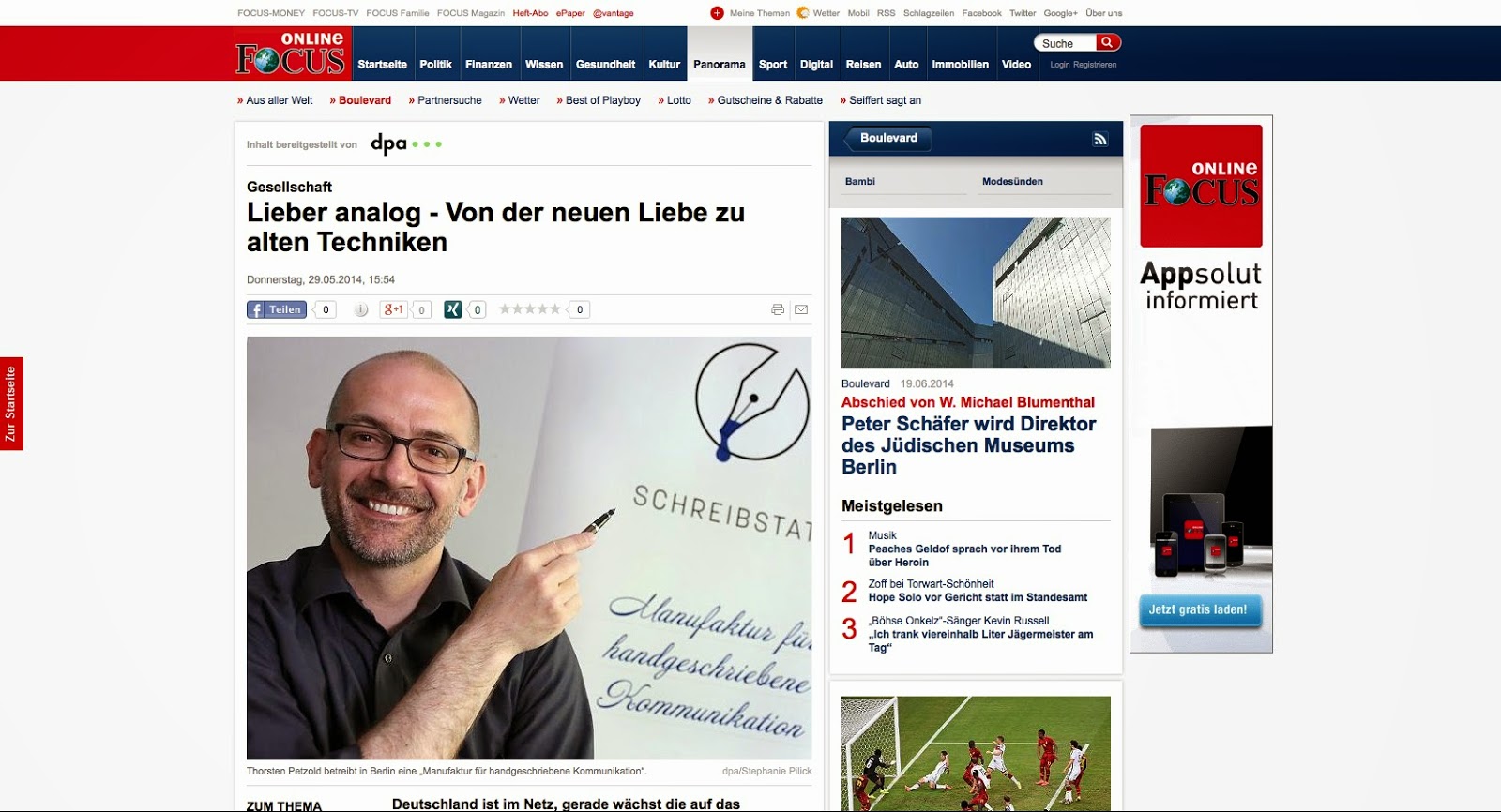
LIEBER ANALOG - VON DER NEUEN LIEBE ZUR ALTEN TECHNIK
-------------------------------------------------
Berlin - Deutschland ist im Netz, gerade wächst die auf das Smartphone starrende Generation «Kopf unten» heran. Aber auch in der digitalen Welt hängen Menschen an alten Dingen, an Schreibmaschinen, Briefen, Polaroid-Kameras.
POLAROID SIND «ETWAS EINZIGARTIGES»
Polaroids? Ja, die gibt es noch, nicht nur in der Kunst. Enthusiasten retteten 2008 nahe der deutsch-niederländischen Grenze die weltweit letzte Polaroid-Filmfabrik («The Impossible Project»). Heute werden die Filme für die Sofortbildkameras mit anderen Chemikalien als früher hergestellt und entwickeln sich langsamer, erklärt Fotograf Oliver Blohm (26) in einem Berliner Laden, der die analogen Filme und Kameras verkauft.
Blohm gibt Kurse im Fotografieren und Experimentieren mit der Polaroid-Technik. „Farben sind bei Polaroid etwas Einzigartiges“, sagt er. Er mag das Unkalkulierbare an der Technik, den „Raum des Unerwarteten“. Manchmal kann eine Ecke fehlen oder die Farbe ist verschoben. Viele seien gelangweilt von der digitalen Technik, sagt Blohm. Ihm liegt sie nicht. „Man muss sich damit wohlfühlen, was man macht.“
---
FULL ARTICLE ON DIE WELT
REVISTA PICNIC | OLIVER BLOHM: LA FOTOGRAFÍA INHALANDO TIEMPO

OLIVER BLOHM: LA FOTOGRAFÍA INHALANDO TIEMPO
-------------------------------------------------
Recién egresado de la carrera de Diseño gráfico y comunicación y con un trabajo fotográfico envidiable, Oliver Blohm es un científico de la imagen. Fue en su universidad donde, haciendo uso de los cuartos oscuros del laboratorio, comenzó a explorar diferentes técnicas fotográficas y a introducir elementos insospechados para la manipulación visual.
Si intentáramos definir el proceso mediante el cual crea esas imágenes que por momentos adquieren un aireprerrafaelista, encontraremos hornos de microondas yexperimentos con fuego como ingredientes clave en las diferentes fases de revelado e impresión.
Sus fotografías de inmediato nos hacen pensar en viejas técnicas y a diferencia de las imágenesperfeccionadas ynítidas, las de Oliver parecen estar emergiendo todo el tiempo, como si de manera permanente formaran parte del negativo o incluso, estuvieran aún en contacto con el revelador como fantasmas a punto de aparecer.
---
FULL ARTICLE
THE APP WHISPERER | OLIVER BLOHM'S MIRCROWAVED PICTURES

OLIVER BLOHM'S MIRCROWAVED PICTURES
-------------------------------------------------
Today we are publishing the twelfth of a series of ‘Impossible’ articles, this time with Oliver Blohm, born and raised in a little village near the Baltic Sea in Germany, Blohm started studying Communication Design and photography. Now settled in Berlin, he keeps exploring alternative and experimental photography.
One of his experimentations involves the use of a… microwave. You might think that Instant Photography and microwaves have nothing in common, and we must admit that these kind of experimentations are not the safest – but they do provide amazing and unique results!
Oliver’s experiment started with an effort to speed up the processing time of Impossible pictures. Finally, he decided to put an Impossible picture between a piece of glass and a wet carton firmly hold together in a microwave for a few seconds. Blohm managed to get the development time back down to two or so minutes. Yet, this experiment came with a side-effect.
The use of a microwave led to unique faults in the Impossible picture, such as textures, shapes, and burns. Oliver kept on experimenting and refining the process until he found the perfect time and power. He created a series of one-of-a-kind images that are burned, torn and partially destroyed: Hatzfrass Fastfood.
---
FULL ARTICLE
Subscribe to:
Posts (Atom)